






TL;DR
-
Businesses lose customers without ever knowing why: Most consumer decisions come down to a handful of factors that are well within any business's control
-
#1 rankings aren’t everything: Strong reviews, location, and clear pricing matter when consumers are researching and choosing a business
-
Customers favor active listings: Missing information, old reviews, and neglected listings cost local businesses customers
Every day, consumers are judging businesses just like yours based on their online presence. For the businesses that get it right, it’s a major opportunity. Get it wrong, and potential customers will move on without a word. No feedback, no warning, and no second chance to make a first impression.
So how can you know what to improve if customers are only telling you with silence?
We put that question to 1,200+ active local searchers: real consumers who had all searched for a local business online in the last three months. That’s not a niche group: 84% of US consumers searched for a local business in the last three months.
Earlier in this series, we’ve explored how consumers find and choose local businesses online. Parts one and two covered how fast these decisions happen, and which channels matter most.
Now, we’re getting to the part businesses really need to hear: why consumers choose one business over another, and what you can do to make sure you’re the top choice. The good news is that most of it is well within your control.
Here’s what they told us.
Consumers don’t just click #1
In the first part of this series, we learned that 72% of consumers look at just three or fewer businesses before making a decision. This limited shortlist means that those that fall outside the top three could risk being invisible to their target market.
When searching for a local business, most people assume the top result wins the customer. While rankings are important for improving your chances of appearing in that all important shortlist, they are only one part of the story.
We asked consumers what they actually care about when researching local businesses, and only 6% “just clicked the top result”.
Instead, most people looked at a range of factors that mattered to them before committing to a click.
What matters to consumers during the research stage
| Rank | Factor | % |
|---|---|---|
| 1 | The address or how nearby it is | 44% |
| 2 | The star rating | 38% |
| 3 | The number of reviews | 37% |
| 4 | Whether the listing had complete information | 34% |
| 5 | If there was clear pricing or a deal/offer | 30% |
| 6= | Photos of the business or its work | 24% |
| 6= | The category or type of service listed | 24% |
| 8 | How high in the results the business appeared | 16% |
| 9 | The business name or how professional it sounded | 14% |
| 10 | Whether the listing was an advert | 11% |
| 11 | Just clicked the first result | 6% |
Proximity is the most important factor to consumers who are in the research stage, with 44% looking at the address or how close the business is before clicking on it to learn more.
Unless you’re just starting up, how close you are to customers isn’t something you (or your competitors) can change. Instead focus your energy on the things you can control. Reviews, clear information, and pricing are all things you can actively work on, and they’re what consumers are actually comparing when researching.
Different channels come with different expectations
Part two of this series showed that while Google is the most common starting point, three quarters of consumers used more than one channel in their most recent search.
75%
of consumers used more than one channel during their most recent local business search (source)
Whether a customer finds you via Google or another channel can have an impact on what matters during the research stage. Reviews and proximity are the priority across nearly every channel, but there are a few channel-specific quirks worth knowing.
Proximity matters most to people that use Google Search, Google Maps, and review / business listing sites, but it is less important to people using voice search or AI tools. People using Yelp or similar review sites understandably place even more emphasis on reviews, with 49% looking at review count and 48% at star rating.
| Google Search | Google Maps | Social media | AI tools | Other search engines | Voice search | Review sites / business listings | Apple Maps | |
|---|---|---|---|---|---|---|---|---|
| How high in the results the business appeared | 15% | 18% | 26% | 30% | 25% | 30% | 26% | 24% |
| The star rating | 42% | 42% | 44% | 36% | 42% | 31% | 48% | 38% |
| The number of reviews | 41% | 42% | 37% | 37% | 38% | 31% | 49% | 30% |
| Photos of the business or its work | 26% | 28% | 32% | 32% | 25% | 26% | 40% | 33% |
| The business name or how professional it sounded | 15% | 19% | 21% | 27% | 22% | 20% | 24% | 26% |
| The address or how nearby it is | 47% | 49% | 41% | 37% | 42% | 33% | 45% | 43% |
| Whether the listing had complete information | 37% | 36% | 30% | 27% | 40% | 30% | 38% | 38% |
| The category or type of service listed | 25% | 26% | 26% | 28% | 28% | 25% | 33% | 30% |
| Whether the listing was an advert | 11% | 16% | 15% | 17% | 14% | 17% | 22% | 19% |
| If there was clear pricing or a deal/offer | 32% | 30% | 35% | 32% | 35% | 29% | 33% | 32% |
| Just clicked the first result | 5% | 5% | 5% | 5% | 8% | 4% | 3% | 4% |
People using AI tools are far more likely than the average to care about the business name or how professional it seems (27%, compared to an average of 16%). This makes sense as there’s often less context to quickly evaluate a business on, so the name and how professional it seems carry more weight.
But no matter the channel, the fundamentals matter most. Show up with great reviews, accurate information, and an active presence and you give yourself a real chance of being chosen wherever your customers search.
Distance matters, but not to everyone
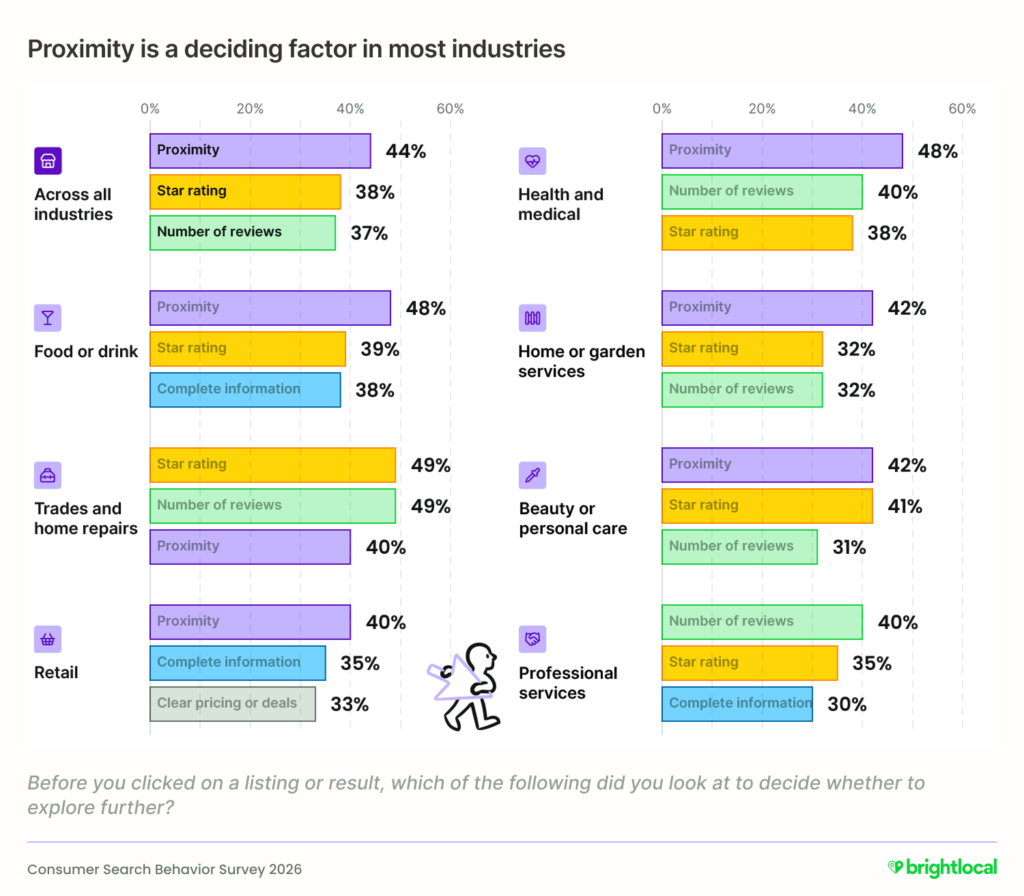
The factors that influence consumers during the research stage aren’t identical across every type of business. While reviews and proximity dominate overall, industry type does shift the picture.
For pressional services, reviews are the dealbreaker
For professional services, proximity is less of a priority (29%) than the overall average. Instead, consumers focus more on the number of reviews (40%), star rating (35%), and if information appears complete (30%). When someone is choosing a solicitor or accountant, clear signals that they can be trusted matters more than distance.
For hospitality and medical, it’s proximity
For both food and drink and health and medical businesses, the opposite is true. Proximity jumped to 48% for both industries, making location the dominant factor. If you’re in either of these sectors, local map visibility is your biggest lever. Keep your address accurate across every channel and make your listings stand out to local customers looking now.
For trades and home services, transparent pricing is important
For trades and home services businesses, star rating and number of reviews carry more weight than any other industry. Pricing and deals also matter more here than elsewhere, with 36% of trade customers citing this as a research factor. If you work in trades, being upfront about your rates or offering a clear way to get a quote could help you get ahead of the competition.
Clarity wins business, alongside reviews and proximity
Showing up across all the right channels and ranking well is only half the battle. Even if a customer has found you while researching, you’re still up against every other business on their shortlist. So what separates the businesses that get chosen from the ones that aren’t on customers’ radars?
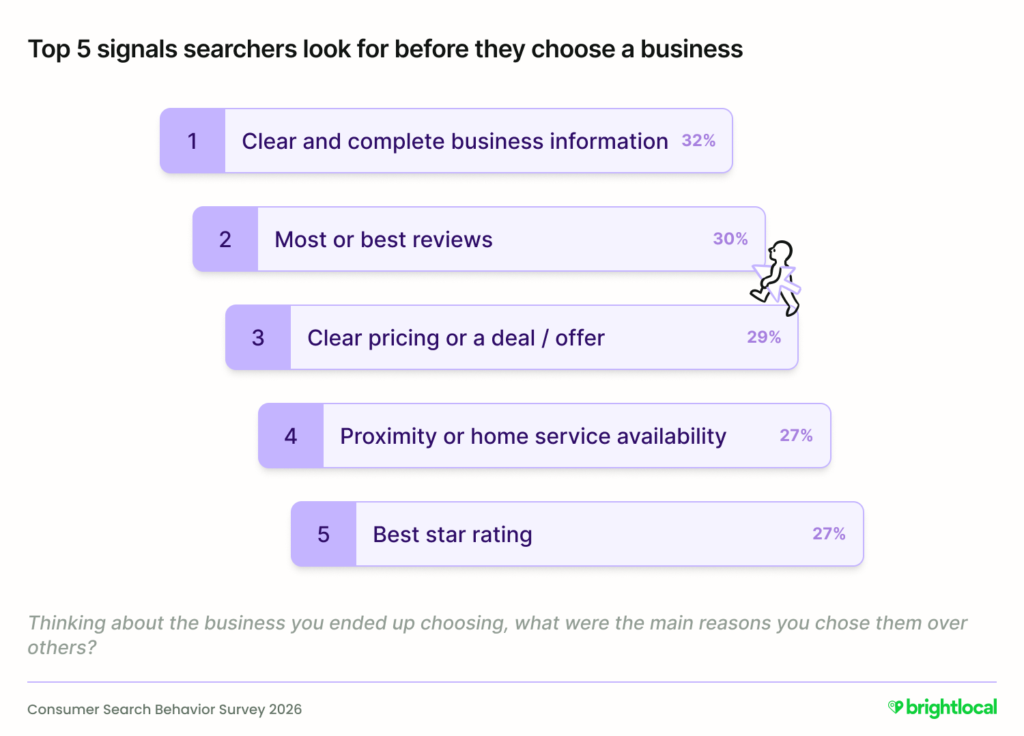
We asked consumers to rank the factors that influenced which business they decided to contact or visit when making their latest local business search. Looking at what made it into consumers’ top three most important reasons gives you a clear picture of where to prioritize your efforts.
The factors affecting decisions the most
| Rank | Factor | % |
|---|---|---|
| 1 | Clear and complete information (hours, address, phone) | 32% |
| 2 | The most or best reviews | 30% |
| 3 | Clear pricing or a deal/offer | 29% |
| 4= | The closest or able to come to the customer’s home | 27% |
| 4= | The best star rating | 27% |
| 6 | A friend or family member had recommended them | 25% |
| 7= | They responded quickly after I made an initial enquiry | 22% |
| 7= | I recognized the business name | 22% |
| 9 | They had a professional-looking website (20%) | 20% |
| 10= | They had the best photos | 18% |
| 10= | They appeared first or near the top of the results | 18% |
Every factor on the list mattered to someone. Even those at the bottom (i.e. appearing at the top of results, having good photos, and a professional-looking website) influenced real decisions. But if you’re deciding where to focus first, the top five should be your starting point.
Proximity aside, so much of this priority list is within your control. It all comes down to how well you present your business online:
- Claim your Google Business Profile and other important business listings (Local citation building services)
- Keep information accurate (Manage listings)
- Build positive reviews (Track and request reviews)
- Present yourself professionally online
- Be clear on pricing
It may sound like the basics, but this is what really matters. If your business leaves them with doubts, your competitor could be the one getting the call.
Pricing and offers round out the top three. Consumers want to know what they’re getting into before making contact. Where you can share pricing information, make it easy to find. Where you can’t, at least make it easy for people to ask.
And when they do find you, think about what happens next. A click to call, a booking button, or a map link all reduce the friction between seeing you online and actually choosing you. Small tweaks that make it easy to act can be the difference that helps get a customer over the line.
Your online presence is making decisions for you
Most businesses assume they’ll know if they’re losing customers. But in reality, a significant number of customers are lost before they ever get in touch.
56% of consumers have been unable to find a suitable local business at some point during a search because businesses were too far away, had too few reviews, or simply didn’t seem right. During their most recent search alone, 52% looked at a business and decided not to contact them. The business never even knew they were there.
52%
looked at a business and decided not to contact them.
As we found in part one, most consumers decide on a business within just 30 minutes, with more than a quarter making a decision in less than five. That means there’s very little time or opportunity to recover if your listing puts someone off.
So what are the red flags that customers notice? Consumers chose not to contact a business due to:
| Rank | Factor | % |
|---|---|---|
| 1 | Negative reviews | 33% |
| 2 | Unclear pricing or no offers | 32% |
| 3 | Low star rating | 30% |
| 4 | No or few review | 24% |
| 5 | Out-of-date reviews | 21% |
| 6 | Missing or incorrect information | 20% |
| 7 | Couldn’t find a website | 18% |
| 8= | No photos on the listing | 16% |
| 8= | The listing looked abandoned or unclaimed | 16% |
| 10 | Didn’t appear high enough in the results | 13% |
| 11 | The listing was a paid advert | 11% |
Reviews dominate this list. 65% were put off by one or more review-related reasons, making reviews the single biggest priority for any local business trying to convert more customers. But look closer, and another important pattern emerges.
Abandoned listings could get you ghosted
No reviews, old reviews, missing information, no photos, and abandoned listings are all signs of a business that isn’t paying attention to how it appears online. 62% of consumers who were put off cited at least one reason related to inactivity.
People notice if you take your foot off the pedal. 96% of consumers think it’s important for a local business to actively manage how they appear online, with 33% calling this essential.
The businesses being rejected aren’t always the ones with the worst reputation. Sometimes they’re just the ones where it seems like nobody’s home.
The Smarter Way to Manage Listings
Don’t give customers a reason to walk away
Consumers aren’t sitting around waiting for a business to fall on their lap. Rather than digging through information to find the truth, customers are looking for enough signals to make a confident decision.
The encouraging part is that most of the things customers care about are within your control. Positive reviews, accurate information, recent activity, and clear pricing all help build confidence. Ranking well might get you onto the shortlist, but it’s not a guarantee you’ll be chosen.
But you have to remember, your online presence is always on, even if you aren’t. An outdated listing, poor reviews, or confusing pricing can be the red flag that costs a business customers. Businesses that keep things accurate and active are the ones with the best chances of standing out.
If you want to give your business the best chance of being chosen, focus on the fundamentals:
- Make sure your business information is complete and up to date across every channel
- Build a steady stream of recent reviews and respond to the ones you have
- Don’t let a #1 ranking stop you from improving your business online
- Be as clear as possible about pricing, or make it easy for customers to request a quote
- Regularly check how your business appears online from a consumer’s point of view. Would you contact you?
The businesses that win customers aren’t always the ones with the biggest budgets or hundreds of reviews. They’re the ones that look like an obvious choice before anyone clicks.
This is the final piece in our three-part research series on how consumers find and choose local businesses (if you missed the first two, catch up here). But what consumers want is only one side of the story. Next, we’ll explore how closely local businesses are matching those expectations, and where the biggest gaps lie. Sign up for our newsletter to be the first to find out.
Methodology
This report was conducted using a representative panel of 1,227 US-based consumers that had conducted an online search for a local business in the last three months.
Publications and individuals are welcome to use our research findings, graphics, and data, citing BrightLocal as the author and the page URL: https://www.brightlocal.com/research/consumer-search-behavior-decisions/


![How to choose the right local SEO services for your business [+free downloadable checklist]](https://brightlocal-corp-assets.s3.amazonaws.com/brightlocal-corp-2026/wp/uploads/2026/04/brightlocal-the-right-local-seo-services-illustration-resources-blog-1080x480-1-768x341.png)