







Key takeaways
-
Everyone is searching for a local business: 84% of consumers have searched for a local business in the past three months
-
Decisions happen fast: Most people choose a local business in under 30 minutes, and for some, that window is much smaller
-
The shortlist is short: Consumers only consider a handful of businesses before making their choice, whatever channel they're searching on
Ever feel like your business is invisible online? Even if you think you’re doing all the right things in all the right places, potential customers may not even be seeing you.
We know how hard it is to get found by your customers, so we wanted to find out what’s actually happening when people search for local businesses online. We surveyed 1,200+ US consumers about their most recent local business search (from restaurants and hair salons to dentists and tradespeople), and asked exactly what that search looked like.
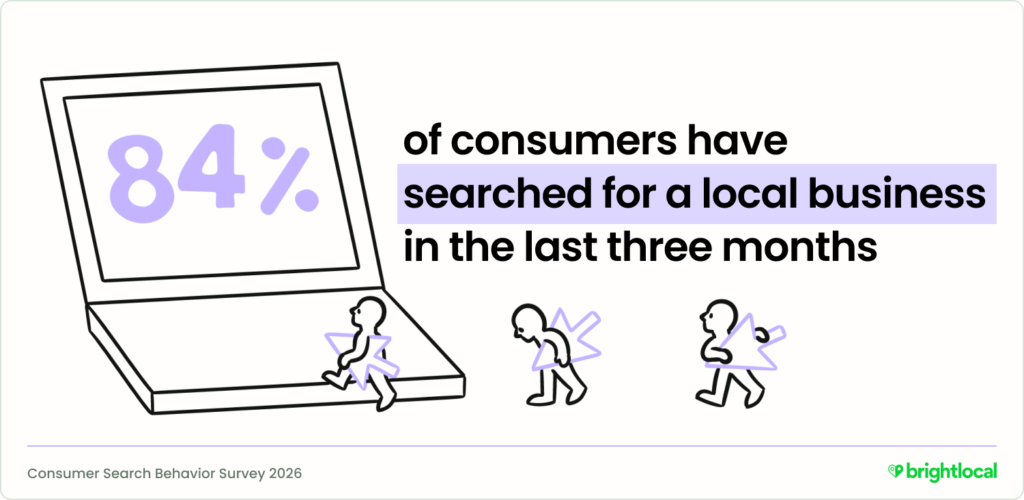
A full 84% of consumers have searched online for a local business in the last three months. That’s a lot of people actively looking for a business like yours. But with most of them making a decision before the hour is out, do you think your online presence does enough to make you stand out?
We’ll be exploring exactly how consumers find and choose local businesses online. In the first of the series, we’re starting with speed: how quickly people make a decision, how many businesses they actually consider, and how factors like intent and industry type change the story.

"Consumers are not hanging around"
Myles Anderson, Co-founder and CEO at BrightLocal
“It’s clear from the data that most consumers want to make quick decisions on the businesses they use. The pace of life is ever-increasing. We want quick action. Coupled with this, our confidence in Google results has increased to the point that we implicitly trust it to return the best options available. The vast majority of consumers don’t feel the need to look past the top three and dig further. For a local business, that makes being at the top of the results matter more than ever. Getting your marketing and local SEO right so you’re found at the top is critical to your growth and success more than ever before.”
Let’s put it this way: your customers don’t hang around, so neither should you.
Most decisions are made in 30 minutes, but over a quarter take less than five minutes
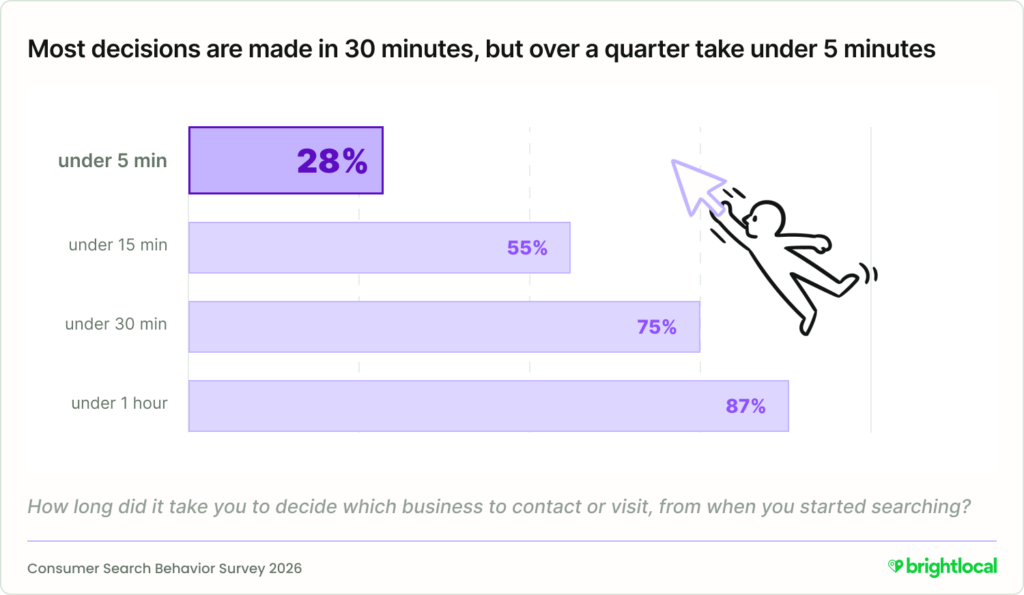
Local search isn’t a long process. Consumers aren’t spending hours poring over websites, social posts, and the finer details before making their pick.
75%
of consumers take less than 30 minutes to decide which business they want to use.
For 28% of people, that decision is made in under five minutes. Barely enough time to scroll through a few listings and skim some reviews. Speedy decisions mean that small businesses don’t have much time to impress.
Even window shoppers don’t take long
Not every person searching for a local business is ready to buy. Someone checking opening hours is in a very different headspace from someone who’s still weighing up options. So how does the intent of a search change the speed of a decision?
| Timescale | I wanted to check the details of a specific business I already had in mind, such as their phone number | I was ready to contact or visit a business and just needed to find one | I was looking at a few options before deciding who to use | I was researching costs or options, but was not ready to contact anyone yet |
|---|---|---|---|---|
| Less than an hour | 87% | 91% | 82% | 72% |
| Less than 30 minutes | 82% | 81% | 73% | 63% |
| Less than 15 minutes | 68% | 57% | 51% | 42% |
| Less than 5 minutes | 40% | 32% | 21% | 21% |
People who are ready to act decide fast, while those still in the research phase take a little longer. But even they act quickly.
Decision speed also varies depending on industry, but even some of the ‘slower’ types of business don’t take much time:
| The “quickest” industries (most likely to take five minutes or less) | The “slowest” industries (least likely to take five minutes or less) |
|---|---|
| 1. Food and drink | 1. Professional services |
| 2. Retail | 2. Trades or home repairs |
| 2. Home or garden services | 2. Beauty or personal care |
Food and drink decisions rarely need much thought. People are hungry and want something quick, and (as we’ll find out later in this series), nearby.
Decisions on professional services need a bit more time to allow customers to feel confident they’ve picked a business they can trust.
But decisions still happen pretty quickly for these ‘slow’ industries. Just 10% of people spend more than an hour researching professional services before committing to a choice.
What does this mean for your business?
Since decision speed varies by industry, it’s worth thinking about what your customers need to confidently choose you.
For slower-moving industries this could be detailed reviews, clear information on the services you offer, and evidence like case studies or before-and-after photos to help them trust you before making contact. The good news is that you have a little more time to make this case, but don’t make it hard to find.
If you’re in an industry where decisions happen more quickly, the priority should be to remove every barrier between a customer and their decision. Think about what your customers actually need at that moment: a menu, a booking link, or directions to find you. If they have to dig for it, you’ve already lost them.
Not sure what makes your customers choose your business over a competitor? We’ll be exploring exactly that later in this research series.
Most customers only add three businesses to their shortlist
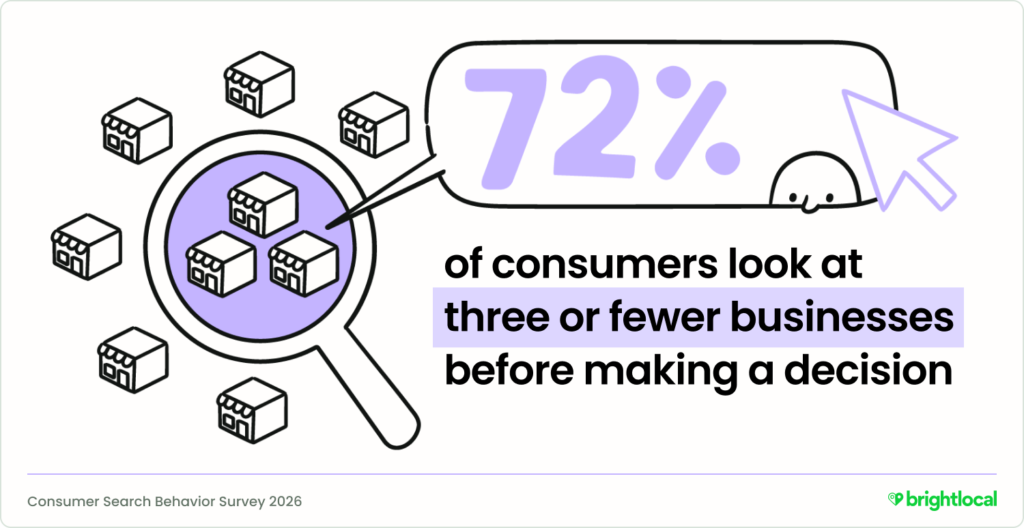
With such short decision windows, most consumers simply aren’t looking at many businesses before they choose.
72% of consumers look at three or fewer businesses before making a decision. Only 1% look at more than ten.
Businesses languishing on the second page of search engines have virtually no chance of making the shortlist. You might think you’re competing with every local business in your industry, but most consumers are only comparing three. If you aren’t in those three, you aren’t even in the running.
But this isn’t just about search rankings. This pattern remains the same when looking across all of the main channels consumers use to find local businesses online, including Google, review sites, social media, and AI tools.
It’s worth pointing out that only looking at three businesses doesn’t necessarily mean the top three businesses shown by a channel, just the three that caught consumers’ eyes. But if you’re not showing up where your customers are looking, your chances of even making the shortlist are low.
Even researchers don’t compare lots of businesses
The intent behind a search also affects how many businesses are considered, though the numbers remain low.
| No. of businesses | I wanted to check the details of a specific business I already had in mind, such as their phone number, address, or opening hours | I was ready to contact or visit a business and just needed to find one | I was looking at a few options before deciding who to use | I was researching costs or options, but was not ready to contact anyone yet |
|---|---|---|---|---|
| Only 1 — I contacted the first result I found | 27% | 22% | 8% | 11% |
| 3 or fewer businesses | 80% | 77% | 71% | 53% |
| 5 or fewer businesses | 89% | 89% | 89% | 73% |
| 6-10 businesses | 3% | 4% | 2% | 3% |
| More than 10 businesses | 0% | 3% | 1% | 1% |
People who are ready to buy narrow down options quickly, while people who are still deciding look at more businesses. But even consumers still firmly in the research stage only explore five or fewer businesses. The consideration set stays small wherever someone is in their decision-making journey.
The window is small, so make sure you’re in it
No matter your industry, the channel, or how ready someone is to get in touch, decisions happen far faster than most business owners expect. For industries where decisions happen in minutes based on only a few businesses, even the slightest friction could send someone straight to a competitor.
To give your business the best chance of standing out:
- Claim and fill out your Google Business Profile
- Think about where your business shows up online, because if you aren’t near the top, you may not make the shortlist
- Create a website, even if it’s just one page showcasing what you do
- Keep reviews recent, detailed, and reflecting your business at its best
- Make sure key information is easy to find and accurate, as consumers won’t dig for it
The businesses that get chosen aren’t necessarily the ones with the most reviews, or the flashiest website. They’re the ones that are front and center when consumers are looking, and make it easy for a busy person to quickly answer: “Is this business right for me?”
"The fundamentals of local SEO are more important than ever"
Myles Anderson, Co-founder and CEO at BrightLocal
“If being found at the top of results matters more than ever, it’s worth being clear about what actually gets you there. It’s all about getting the foundations right. Those foundations are a well optimized and accurate Google Business Profile; a well-structured website with content that reinforces what you do, where you do it, and what makes you different; creating a consistent view of your business through citations and links; and building a steady stream of positive reviews across Google, Yelp, and other key review sites.
None of this is new. These fundamentals have always mattered, but with the evaluation window shrinking, getting them right matters more than it ever has.”
In the coming weeks, we’ll be exploring more of what drives these decisions, starting with where consumers are actually looking for local businesses online. Spoiler alert: it’s not just a Google game, as 2/5 consumers started their most recent local search on a different channel. If you want to get a better understanding of how your customers behave online, watch this space!
Methodology
This report was conducted using a representative panel of 1,227 US-based consumers who had conducted an online search for a local business in the last three months.
Publications and individuals are welcome to use our research findings, graphics, and data, citing BrightLocal as the author and the page URL: https://www.brightlocal.com/research/consumer-search-behavior-speed/
Want to make sure you see BrightLocal’s key updates on local search? Click this link to make us a ‘preferred source’ on Google search. (Learn about preferred sources)