






FREE LOCAL SEO TOOL
Local RankFlux
Be the first to know about changes to Google’s local search algorithm.
Local RankFlux is the only ranking fluctuation monitoring tool for local search. We track daily ranking movements across 14,000+ keywords to measure volatility and identify suspected algorithm updates.
Local RankFlux is the only ranking fluctuation monitoring tool for local search. We track daily ranking movements across 14,000+ keywords to measure volatility and identify suspected algorithm updates.
Try our other free tools
Get quick insights into your local search performance — no setup, no cost, no SEO expertise required.
Our free tools help with your local SEO needs.
Our free tools help with your local SEO needs.
Local SERP Checker
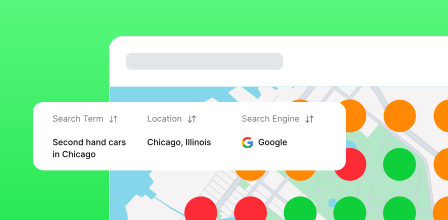
See what customers see in search
View Google search results from any location to understand how your business appears to nearby customers in local search and how you compare to competitors.

Google Review Link Generator
Make it easier for customers to give feedback
Get links to your Google Business Profile. Perfect for sharing with customers and encouraging engagement.

Try the BrightLocal platform free for 14 days
Track rankings, manage listings, and grow your reputation from one place.
All features. Unlimited access. No card required.
Frequently asked questions

We’ve gathered the most common questions our community asks to help you move forward with total confidence. If your question isn’t there, we’re only a message away.
We expect to see small changes in ranking positions every day, as some businesses go up and down in the results based on changes in their SEO and how Google values them. This means that we expect a certain amount of fluctuation in the Local RankFlux score each day.
However, when Google releases a significant change to its local search algorithm, we will see a bigger fluctuation and therefore a higher score.
Daily Local RankFlux Scores:
0-3 indicates ‘low’, expected fluctuation (i.e., nothing significant has happened)
3.1-6 indicates ‘medium’ fluctuation (i.e., something minor has happened)
6.1-10 indicates ‘high’ fluctuation (i.e., something major has happened – likely a local algorithm update)
Please note: the expected daily fluctuation levels differ between industries, i.e., hotels, restaurants, and pubs see greater daily fluctuation and volatility than other industries. We’d recommend bearing this in mind when looking at scores for specific industries.
However, when Google releases a significant change to its local search algorithm, we will see a bigger fluctuation and therefore a higher score.
Daily Local RankFlux Scores:
0-3 indicates ‘low’, expected fluctuation (i.e., nothing significant has happened)
3.1-6 indicates ‘medium’ fluctuation (i.e., something minor has happened)
6.1-10 indicates ‘high’ fluctuation (i.e., something major has happened – likely a local algorithm update)
Please note: the expected daily fluctuation levels differ between industries, i.e., hotels, restaurants, and pubs see greater daily fluctuation and volatility than other industries. We’d recommend bearing this in mind when looking at scores for specific industries.
We track a massive data set: 28 keywords x 26 industries x 20 cities = 14,560 keywords (560 per industry).
Local RankFlux plots the ranking position of each business in the top 20 search results and compares that ranking to the previous day’s position to determine the daily change.
Higher rankings (i.e., #1-2) have greater significance and ranking value than lower rankings (i.e., #19-20) and are therefore given a higher weighting in the Local RankFlux score calculation.
So, if a business moves from position #2 to #4, this represents a bigger fluctuation than a business that moves from #19 to #17, and the Local RankFlux calculation takes this into account.
Local RankFlux then multiplies the change in position between today’s and yesterday’s rankings by the weighting to create a total daily fluctuation. This total is then converted into an average based on the number of keywords that returned meaningful results, and a score is produced for all industries and for each individual industry.
(For all keywords) Change in position x weighting = Total Daily Fluctuation
Total Daily Fluctuation / Number of Keywords = Average Fluctuation Score
Daily fluctuation scores are then plotted on the Local RankFlux chart.
*We ignore paid-for positions in results and only consider the non-paid results. Any new businesses that appear in the top 20 results but weren’t there the day before are presumed to have been in #21 the day before (it’s not an exact science, but it’s the only way we can treat these). Each day a small percentage (circa 5%) of keywords returns results that we suspect are inaccurate (i.e. they show less than 20 results whereas the day before they do show 20). We strip these results out so they don’t skew the accuracy of the Local RankFlux score.
Local RankFlux plots the ranking position of each business in the top 20 search results and compares that ranking to the previous day’s position to determine the daily change.
Higher rankings (i.e., #1-2) have greater significance and ranking value than lower rankings (i.e., #19-20) and are therefore given a higher weighting in the Local RankFlux score calculation.
So, if a business moves from position #2 to #4, this represents a bigger fluctuation than a business that moves from #19 to #17, and the Local RankFlux calculation takes this into account.
Local RankFlux then multiplies the change in position between today’s and yesterday’s rankings by the weighting to create a total daily fluctuation. This total is then converted into an average based on the number of keywords that returned meaningful results, and a score is produced for all industries and for each individual industry.
(For all keywords) Change in position x weighting = Total Daily Fluctuation
Total Daily Fluctuation / Number of Keywords = Average Fluctuation Score
Daily fluctuation scores are then plotted on the Local RankFlux chart.
*We ignore paid-for positions in results and only consider the non-paid results. Any new businesses that appear in the top 20 results but weren’t there the day before are presumed to have been in #21 the day before (it’s not an exact science, but it’s the only way we can treat these). Each day a small percentage (circa 5%) of keywords returns results that we suspect are inaccurate (i.e. they show less than 20 results whereas the day before they do show 20). We strip these results out so they don’t skew the accuracy of the Local RankFlux score.
Yes! We can send updates straight to your inbox. Just fill in the form above. You can choose the pace that works for you: daily, weekly, or urgent alerts (sent only when ‘High Fluctuation’ is detected).
Want to see what other SEOs are saying about today’s numbers? Jump into the discussion on X (Twitter) using #LocalRankFlux. It’s the best place to swap theories when the Map Pack starts acting up.
Have a question about the data or how to read the charts? Just drop us a line at marketing@brightlocal.com, and our team will get you sorted.
Want to see what other SEOs are saying about today’s numbers? Jump into the discussion on X (Twitter) using #LocalRankFlux. It’s the best place to swap theories when the Map Pack starts acting up.
Have a question about the data or how to read the charts? Just drop us a line at marketing@brightlocal.com, and our team will get you sorted.