






If you’ve recently gone looking for the Q&A feature on a Google Business Profile and not been able to find it, you’re not imagining things. Google has now officially discontinued Q&A, replacing it with an AI-powered experience called Ask Maps.
In this guide, we’ll explore what Google Q&A was, why it’s gone, and what local SEOs need to know about its AI-replacement Ask Maps.
What was Google Q&A?
Q&A was a feature within Google Maps that allowed user-generated questions about the business to be asked and answered publicly. Q&As were shown in a business’s Google Business Profile on both Google Maps and in the local Knowledge Panel.
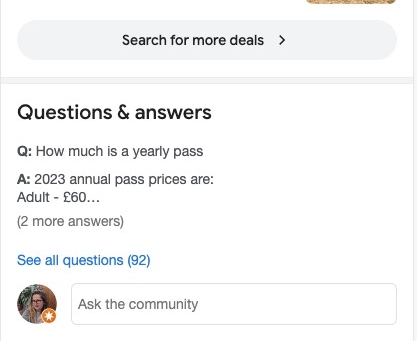
Businesses could wait to be asked a question or write their own FAQs to answer. Q&A was a great way to offer more information about your business to searchers via your local Knowledge Panel.
However, one of the major challenges with Q&A was that anyone could reply to a question that had been asked about a business. This led to many inappropriate or inaccurate answers, which did nothing for customer trust.
Businesses needed to be proactive in managing their Q&A, as unanswered questions or rogue answers could be a reputation management nightmare.
As well, answers to previous questions easily became ‘dated’, for example, if prices or services changed since the question was answered. This meant that Q&As were often unhelpful to both the customer and the business if not monitored and regularly updated.
A history of Q&A changes
So the first hint that Q&A was changing came in September 2025, when Google announced it planned to discontinue the My Business Q&A API, saying it was “in the process of updating the Q&A functionality and user experience.”
Local SEOs began reporting that the ‘Ask A Question’ button was disappearing from live Google listings, as well as ‘Add question’ disappearing for some businesses in the GBP dashboard.
The API was officially retired on November 3, 2025, meaning people could no longer read or post questions and answers using the API.
Then, in December, Google confirmed that Google Q&A was “changing”. Google explained:
“Instead of scrolling through all of the existing FAQs or waiting for a response, customers can ask their question directly in Google Maps and get an updated, instant answer based on your answers and relevant reviews. Instead of answering dozens of specific questions from customers that may grow stale, you can answer aggregated questions from our customers, saving you time. Your answer will then be used to help respond to other customers asking similar questions on Maps.”
Introducing Ask Maps
Once Google Q&A began disappearing, savvy local marketers quickly began theorizing that it would likely be replaced with AI, using Google’s Gemini-powered Ask Maps.
Google shared more information on Gemini’s integration into Google Maps in March 2026:
“We’re introducing Ask Maps, a new conversational experience that answers complex, real-world questions a map could never answer before. Now you can ask for things like, “My phone is dying — where can I charge it without having to wait in a long line for coffee?” or “Is there a public tennis court with lights on that I can play at tonight?” Previously, finding this information meant lots of research and sifting through reviews. But now, you can just tap the “Ask Maps” button and get your questions answered conversationally, with a customized map to help you visualize your options.
Ask Maps is uniquely helpful — tapping into Maps’ fresh information about the world to show you everything you need to know before you go, personalizing responses to you, and making it easy to turn plans into action.
So if you’re planning a trip, just ask: “I’m headed to the Grand Canyon, Horseshoe Bend and Coral Dunes — any recommended stops along the way?” You’ll get clear directions, ETAs, and insider tips from real people, like how to find a hidden hiking trail or get a free entry ticket. To build your itinerary, Maps analyzes information from over 300 million places, including reviews from our community of more than 500 million contributors.”
Essentially, Ask Maps is a Gemini AI-powered answer tool that is integrated into Google Maps. Users can ask Google Maps natural queries like “things to do with friends at night in Boston”, or something specific about a business like “do they have parking?”
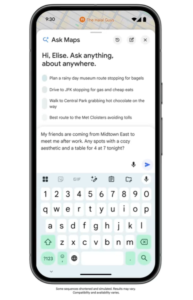
Hit the Ask Maps button in the Google Maps app to start a conversation, and start asking questions like “somewhere relaxed for a low-key birthday dinner with friends in Boston”. Google will then answer your query with recommendations tailored to your request and personalized based on your previous activity in Maps.
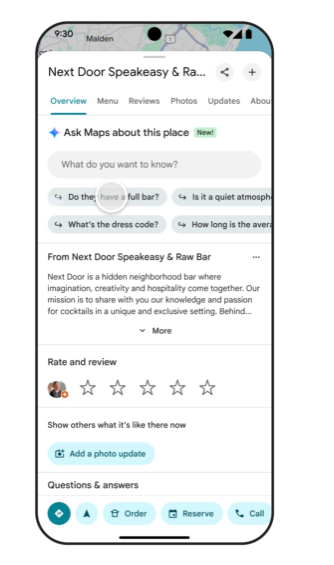
You can also use Ask Maps on a Google Business Profile by asking any question in the search bar under “Ask Maps about this place”, or clicking one of the pre-generated questions created by Google.
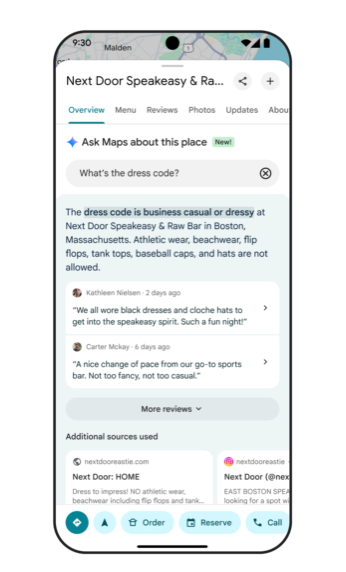
Ask Maps, then displays a short answer to your question. Answers are drawn from the business’s GBP information and reviews, as well as the business’s website. If the information isn’t available there, it then turns to third-party sources. If it still doesn’t know, it will say something like “There’s not enough information to answer your question, but you can ask another question”.
When generating an answer, Ask Maps draws from sources including:
- Your Google Business Profile information: descriptions, services, attributes, hours, photos, and posts you’ve added
- Customer reviews on Google and on other review sites
- Your business website, including service pages, FAQs, and contact information
- Third-party sources if the information can’t be found in any of the above ‘owned’ places
Sources are shown below the answers so you can see where the information is coming from. However, like with most AI tools right now, a healthy dose of fact-checking is strongly recommended.
It’s also worth noting that Ask Maps isn’t available for every business category. Mike Blumenthal’s detailed exploration over on Search Engine Journal found that Ask Maps was missing for healthcare providers, counseling services, and regulated categories like dispensaries. It also isn’t visible for some categories that are prone to spam, like locksmiths, garage door suppliers, and moving companies.
Though it was first announced in October 2024, Ask Maps has been slow to roll out. In March 2026, Ask Maps was still only available in the USA and India on Android and iOS, with promises that this will be coming to Google Maps on desktop soon.
What does Ask Maps mean for local marketers?
The loss of Q&A removes a tactic that many local SEOs used effectively to control the conversation about businesses with on-brand questions and answers. Now that Q&A isn’t an option, what can local marketers do to get ahead with Ask Maps?
The key thing that makes Ask Maps different from Q&A is that it’s generative: constructing a response in real time based on what it can find out.
This means there are no pre-written answers you can easily edit or answers you can simply track. Questions don’t need to have been asked before, and there is no way to know what customers are frequently asking about your business (though Google, if you’re reading, we’d love some insights in the GBP dashboard, please!)
While you can’t control what Ask Maps says, you can make sure it has the best possible information to work from. Here’s where to focus your energy.
1. Check what Ask Maps is already saying about your business
Before making any changes, it’s worth understanding what Ask Maps is currently saying about you.
Think of questions customers may want to know, and test these out to see what information is being surfaced. Note what it says, the sources it cites, and where it gets things wrong. Being generative, answers won’t be the same every time, so it might be worth asking a few times in a few different ways.
Unlike Q&A, there isn’t currently a way to correct or report an inaccurate Ask Maps response. The only fix is to improve the underlying data it’s drawing from. Treat every inaccurate response as a clue: it’s pointing you towards something that needs your attention.
2. Treat the Google Business Profile as Gemini’s primary source of truth
Ask Maps pulls first from the GBP, so gaps and inaccuracies here will show up in generated answers.
Go through your GBP and fill out as much information as possible, and update anything that is out-of-date. Add any attributes, services, and products that are relevant to your business. Check opening hours and add any special hours or opening times for any upcoming holidays.
Ask Maps regularly shows photos from the GBP listing in answers. An up-to-date photo set covering the interior, exterior, products, services, and team can help give a visual to an answer.
If your images no longer represent the business (e.g., photos with old branding, products you no longer carry, or a menu from years ago), make sure to remove these.
3. Prioritize review generation
Gemini reads Google reviews and actively cites them in Ask Maps responses, pulling out specific mentions of services, experiences, and team members.
A business with detailed, recent reviews gives it much better material to work with, so keep review generation consistent. A customer who shares specific details is providing much more useful source material than a generic five-star rating.
When you request reviews from customers, it can help to give a gentle prompt on the details that are useful to include.
Build a 5-star Reputation
4. Build out content on your website
Because Ask Maps draws on the business website as a source, make sure the website is up-to-date and information is easy to find. Ensure your service or product pages are detailed and offer answers to the questions customers may be asking.
It may also be worth creating an FAQ page if you don’t already have one. Cover the things that come up most often with customers, such as hours, services, pricing, etc.
The more useful information your website contains, the more Ask Maps has to pull from, so it doesn’t have to rely on third-party sites that are harder to control.
5. Ask for inaccurate information to be updated
If Ask Maps is surfacing incorrect information from a third-party source, you don’t have to just accept it. When it’s pulling from business listings or review sites, you may be able to update that information yourself. For other websites, the best approach is to go directly to that source and (politely) request an update.
Inconsistent information across the internet creates conflicting signals that can lead to inaccurate AI responses, as well as making it hard for customers to trust what they find.
The Smarter Way to Manage Listings
Discover a cutting-edge solution for effective listings management
The Smarter Way to Manage Listings
Discover a cutting-edge solution for effective listings management
A new chapter for Google Q&A
It’s a little sad to see Google Q&A go. When it was well managed, it was a genuinely useful tool for businesses to get ahead of common questions and help customers know if they should buy from you. But if we’re honest, most businesses never quite got there, and a neglected Q&A section often caused more problems than it solved.
Ask Maps is still in its infancy. Right now, it’s only available in the US and India, and only on mobile, and there’s plenty we don’t know about how it will develop. For now, the best approach is to stay curious, keep testing, and see how things evolve.
The good news is that Ask Maps doesn’t require a huge change in approach for local SEOs that are already adapting to AI search. The fundamentals that have always made for strong local SEO performance position businesses well to show in AI search.
If Ask Maps is available in your area, take some time to explore it: not just for individual business profiles, but for the wider discovery side too. Search for the kinds of queries you’d love your business to show up for, and see what needs to be done to make sure your business is being surfaced in the new Google Maps.